
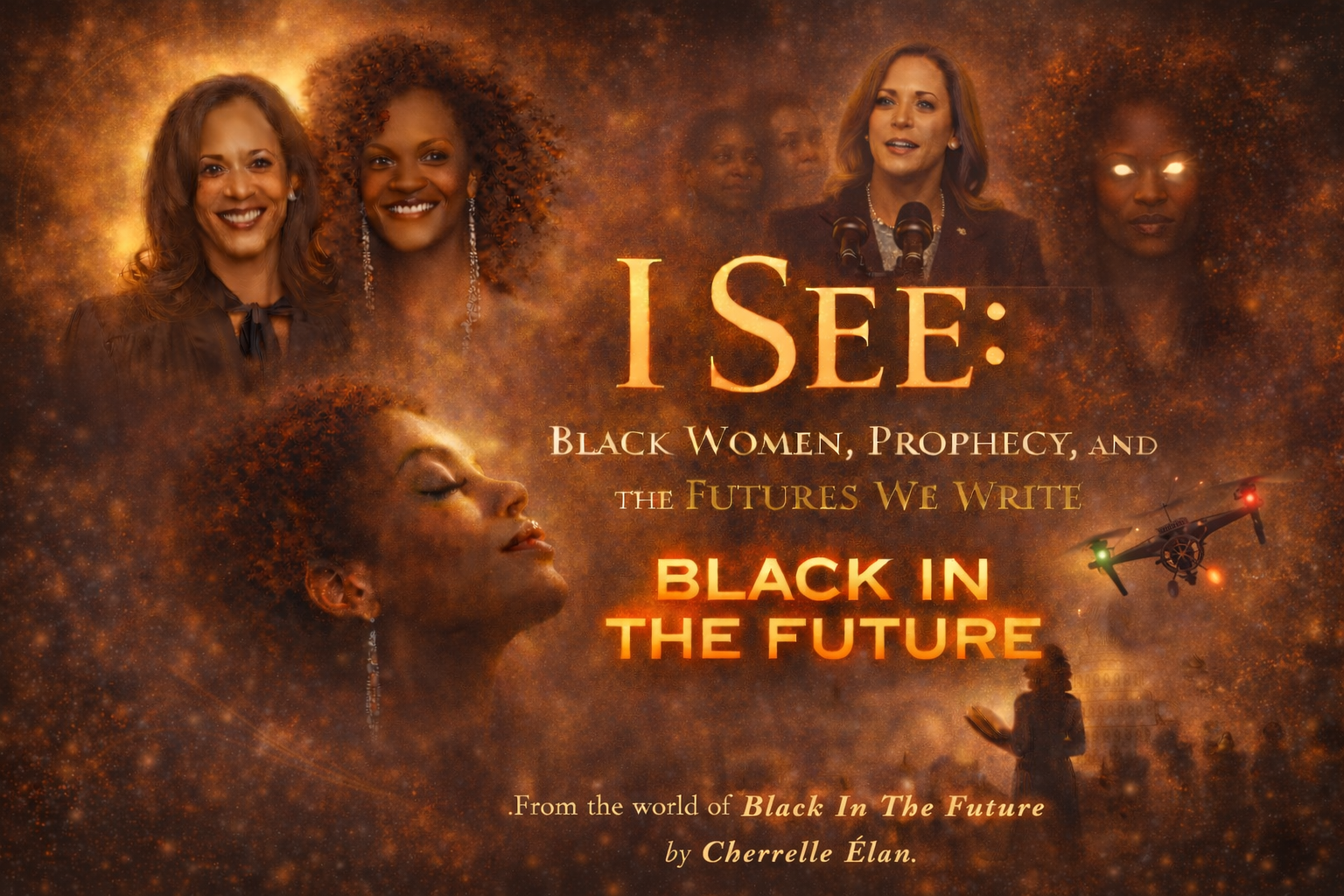
I See: Black Women, Prophecy, and the Futures We Write
I often return to a question raised by photographer and documentarian Phil Borges: when a person experiences reality differently—through visions, dreams, or spiritual insight—is that always mental illness, or might it sometimes be a form of spiritual emergence? Borges has spent decades documenting the lives of shamans and spiritual healers across cultures, challenging Western audiences to reconsider how unusual states of consciousness are interpreted. His work, including the project Crazywise, explores how some societies understand experiences that Western psychiatry might label psychosis as the beginning of a spiritual calling rather than a disorder.
That question resonates deeply with my own life. As a Black woman, I am aware that spiritual expression within Black communities has often been interpreted through a clinical or dismissive framework. Historically, our dreams, intuitive knowledge, and ancestral practices have been labeled superstition or pathology rather than recognized as cultural knowledge. Yet when I look at the history of Black women in America, I see a long lineage of women who served as interpreters of signs, protectors of community knowledge, and guides through uncertainty.
In many communities across the African diaspora, women played roles that bridged the visible and invisible worlds. They appeared as conjure women, spiritualists, midwives, healers, and prophetesses—figures who carried knowledge about dreams, rituals, and intuition. Scholars of African American religion and folklore note that these traditions blended African cosmologies with new realities in the Americas, producing spiritual systems such as Hoodoo and other forms of folk spirituality that helped enslaved and free Black communities survive under oppressive conditions.
Yet the social systems surrounding Black communities have rarely acknowledged these traditions with respect. Research in psychiatry and public health has shown that Black Americans are disproportionately diagnosed with severe psychiatric conditions, particularly schizophrenia and other psychotic disorders. Scholars have suggested that cultural misunderstandings sometimes play a role in this disparity, especially when clinicians misinterpret spiritual language, visions, or religious experiences as symptoms of illness rather than expressions of belief or culture.
At the same time, psychologists and researchers studying religion and mental health have increasingly recognized that spirituality can be a source of resilience. Studies have shown that spiritual practices—including prayer, dream interpretation, and belief in ancestral guidance—often support emotional wellbeing within Black communities. Rather than viewing spirituality and mental health as opposing forces, many scholars now emphasize the importance of culturally informed approaches that respect spiritual meaning while still providing care when necessary.
My interest in this conversation is not purely academic. It comes from my own experiences with intuition and dreams.
For as long as I can remember, my dreams have felt unusually vivid and purposeful. They often arrive with a clarity that makes them feel less like imagination and more like messages that deserve attention. Over time I began to notice that some dreams seemed to anticipate events in my waking life.
One example stands out clearly. Around 2007, I had the same dream on two different nights. In the dream I was backstage at a concert, calmly approaching the musician Prince. The interaction felt personal rather than star-struck. We spoke easily, embraced, and in both dreams I kissed him gently on the forehead.
Years later, in 2014, I met him in person. When that moment occurred, I felt a strange sense of recognition, as if the dream and the present moment were overlapping. Experiences like that reinforced my belief that dreams can function as a kind of intuitive language.
Other experiences deepened that belief. I have found places without directions simply by following a strong internal sense of where to go. I have sensed illnesses affecting people before those conditions were openly discussed. I have dreamed about relationship changes for friends and later watched those situations unfold. Each experience on its own might appear coincidental. Taken together, they created a pattern that shaped how I understand intuition.
For me, prophecy is not simply about predicting dramatic events. It is about recognizing patterns before they fully appear. In that sense, prophecy becomes practical—it helps us navigate life, prepare for change, and respond to possibilities that others may not yet see.
This perspective eventually influenced my creative work. I began developing a speculative storytelling project called Black In The Future. The project began as a short film and grew into a larger narrative world exploring technological and social futures shaped by Black imagination. One of the early stories, Robo-Reparations, imagined a world where technology intersects with historical justice.
Speculative storytelling, I realized, can function like prophecy. When writers imagine futures that do not yet exist, they help audiences visualize possibilities that might eventually become real. Cultural imagination often precedes political or technological change.
That insight also shaped a political intuition I experienced years earlier. After meeting Kamala Harris when she served as California’s Attorney General in 2011, I felt strongly that she possessed the qualities of a future president. By 2016, I believed she would eventually hold the presidency.
At the same time, I recognized the cultural challenge that prediction revealed. In American political culture, many people still imagine a particular image when they hear the word “president.” Historically that image has been overwhelmingly white and male. Even when Black women demonstrate extraordinary leadership, the public imagination often struggles to place them at the highest level of political power.
Because of this, I began to think about cultural storytelling as preparation. Projects like Black In The Future could introduce the image of Black women leading governments, shaping technology, and directing national futures long before such possibilities appear on ballots or news broadcasts.
When prophetic insight does not unfold exactly as predicted, I do not interpret it as failure. Sometimes prophecy reveals potential rather than certainty. It highlights the conditions necessary for a future to emerge. If those conditions—public visibility, cultural familiarity, institutional support—are not fully in place, the timeline shifts.
Understanding this dynamic also requires acknowledging the historical disruption of spiritual knowledge among Black Americans. The transatlantic slave trade, forced religious conversion, and the pressures of assimilation interrupted many traditions that once guided spiritual experiences. Knowledge that might have been passed through rituals, mentorship, and family teachings was often suppressed or hidden.
As a result, many Black women encounter intuitive experiences without the traditional frameworks that might once have explained them. Reconnection therefore happens through a mix of personal study, community dialogue, and creative expression. People find each other in online communities, reading groups, spiritual circles, and family storytelling.
Through my own journey, I have adopted several practices that help me approach intuitive experiences with responsibility and balance.
The first practice is documentation. Keeping a dream journal allows me to record images and emotions before they fade. Over time, patterns become visible that would otherwise be easy to dismiss.
The second practice is community. Even when ancestral traditions are fragmented, guidance can be found through trusted elders, spiritual teachers, or thoughtful peer groups willing to listen without judgment.
The third practice is action. If a dream warns me about a danger or reveals an opportunity, I try to respond in a constructive way. Insight gains meaning when it leads to practical choices that support and protect others.
I often think about younger Black women who may be experiencing similar forms of intuition. Many are taught to ignore their sensitivity or dismiss their inner voice as imagination. Yet historically, those qualities have been sources of leadership and creativity.
Through Black In The Future, I hope to encourage them to see themselves differently—to imagine themselves as architects of future societies rather than observers of someone else’s vision.
Ultimately, the question raised by Phil Borges remains central to this reflection. When someone experiences the world in an unusual way, society must decide whether to silence that experience or listen carefully to its meaning.
Listening creates room for interpretation, mentorship, and growth. Without listening, experiences that might hold insight are easily reduced to labels.
I believe Black women have always carried traditions of seeing—through dreams, intuition, imagination, and storytelling. Even when history attempted to suppress those traditions, the gifts persisted in quieter forms.
My work now is to honor that inheritance. I do that by documenting what I experience, sharing the visions that come to me, and imagining futures where our knowledge shapes the world.
Seeing, after all, is not passive. It is creative. Every dream recorded, every story imagined, and every vision shared becomes part of a larger cultural map guiding us forward.
And through that process, we continue writing the futures we are learning to see.